
Your Gut Feeling Is a Catalogue of Your Own Mistakes
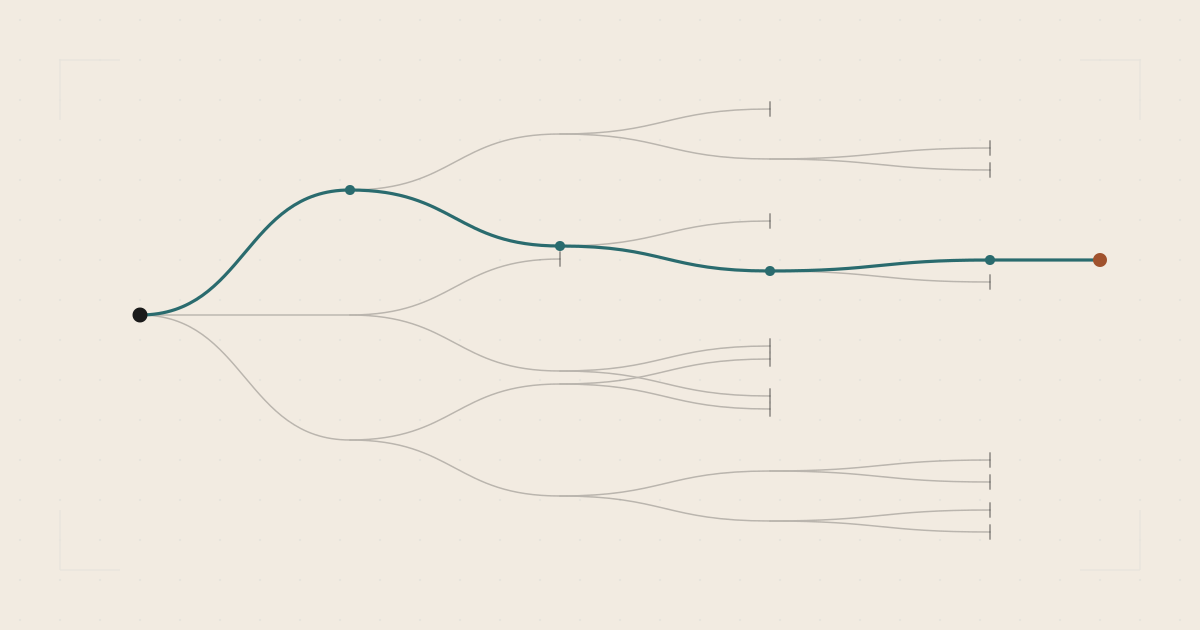
A few days into a new engagement, knowing almost nothing about the business and less about the product, I told the person who had hired me to terminate one of their contracts.
I have tried since to count the hours I actually spent thinking about it. Five, maybe. You could hold them in one hand.
On paper that is indefensible. If you told me that story about somebody else, I would ask what on earth they thought they were doing.
The confidence never came from the data
There wasn't any. I had asked one question on the first day — how do we know we are going to ship on time? — and followed the answer downwards until it stopped making sense. What was supposed to be tracking the work had come loose from reality some time earlier, and nobody had noticed, because a process built for an audience of one always looks immaculate from the outside.
What I had instead was a shape. I had seen that exact shape before — not something like it, that one. The same playbook, run the same way, with the same reassuring surface and the same hollow underneath. I had watched it end badly enough times that I could see the end of this one from very far away.
And the sentence in my head was never I am right. It was: no matter how wrong I am, I cannot be that wrong. That is a much weaker claim. It was also the only one I needed.
Gut feeling is not a sense. It's a search.
There is nothing mystical in any of this, and the mysticism does real damage. We are machines that ingest information from the day we are born until the moment you are reading this sentence, and what we call intuition is the brain finding a match somewhere in all of it. It feels like a sense rather than a search only because the matching happens where we cannot watch it. (You might see somewhere in there my engineering mind at work).
You learn the stove is hot by putting your hand on it. Once. After that you need no theory of thermal conduction and you do not deliberate at the stove. The knowledge is real, it is instant, and it cost exactly one burn.
It is why a good surgeon walks past a bed and says something is wrong here before the chart says anything. Not magic. Thousands and thousands of beds.
Speed is only defensible if you can undo it
On its own, deciding fast is recklessness with better public relations. What makes it defensible is the quiet second question running underneath: if I am wrong, what does it cost to undo?
Jeff Bezos put the cleanest label on it, in Amazon's 2015 shareholder letter. There are decisions that are reversible and decisions that are not. Selling the company is not. Cutting twenty per cent of the workforce is reversible on paper and never in practice, because the price in brand and goodwill and human capital is one you will not pay twice. Almost everything else — the hire, the budget, the vendor, the architecture — is reversible, and we keep treating it as though it isn't.
At one of my previous companies we spent real energy on whether to hire two people or three. It felt weighty from the inside. Then somebody pointed out that new hires here sit inside a six-month probation period — the decision had a return path and a known price. The question shrank immediately. We hired two. It was not a brave call, because it was never an irreversible one.
When the pattern match is strong and the door swings both ways, deliberating longer buys you nothing at all. You are no longer gathering data. You are gathering comfort.
And stalling is not neutral. Not deciding is itself a decision — you have chosen the default, and nobody in the room voted for the default.
I didn't design the process. I found it afterwards.
Years before any of this, my wife and I sat at a table and made a list of pros and cons about moving to Finland for a job at Nokia (yeah really this is all how the last 20 years started... gosh :D ). Not sophisticated. A list on a piece of paper. But at the bottom of it we said something I only understood properly much later: let's try it for two or three years, and if we don't like it, we come back.
That is the reversibility question, asked by two people who had never heard of it.
I have no step-by-step method for making decisions and I have never taken one out of a book. What I have is the habit of looking back at what I actually did and reverse-engineering it — oh, look at that, so that's what I've been doing. The frameworks are labels I put on my own behaviour afterwards. They stick because they name something that was already there.
And if I had known what I was getting into with most of the big ones, I would not have done them. The blessing of ignorance did a lot of the early work.
Twenty years is not the thing that matters
I have been doing this for about twenty years, and that number carries far less weight in the story than it appears to. Time served is not the variable. I know people with two decades behind them who would have needed three months and a steering committee to reach the same conclusion, and been no more right at the end of it.
Experience is what you get if you do the self-reflection job. Otherwise you just go day by day, and I don't like going day by day.
The catalogue does not build itself. Something goes wrong, and the honest instinct is to move on, because looking at it closely is unpleasant, even painful sometimes, and there is already a fire somewhere else. But what makes a pattern retrievable later is not that it happened to you. It is that you went back and named the shape of it — what it looked like from the inside three months before it became obvious to everyone. Without that, you have a bad memory, not a pattern.
You will rarely know what to do to get it right. You will know what not to do to get it wrong the same way twice. That is most of what expertise consists of.
So the question, the next time certainty arrives in five minutes, is not whether you are sure. It is whether you have genuinely seen this before, or whether it merely resembles something.
Your intuition is only ever as good as the mistakes you were willing to look at twice.