What Training For An Ironman Taught Me About Coaching CTOs
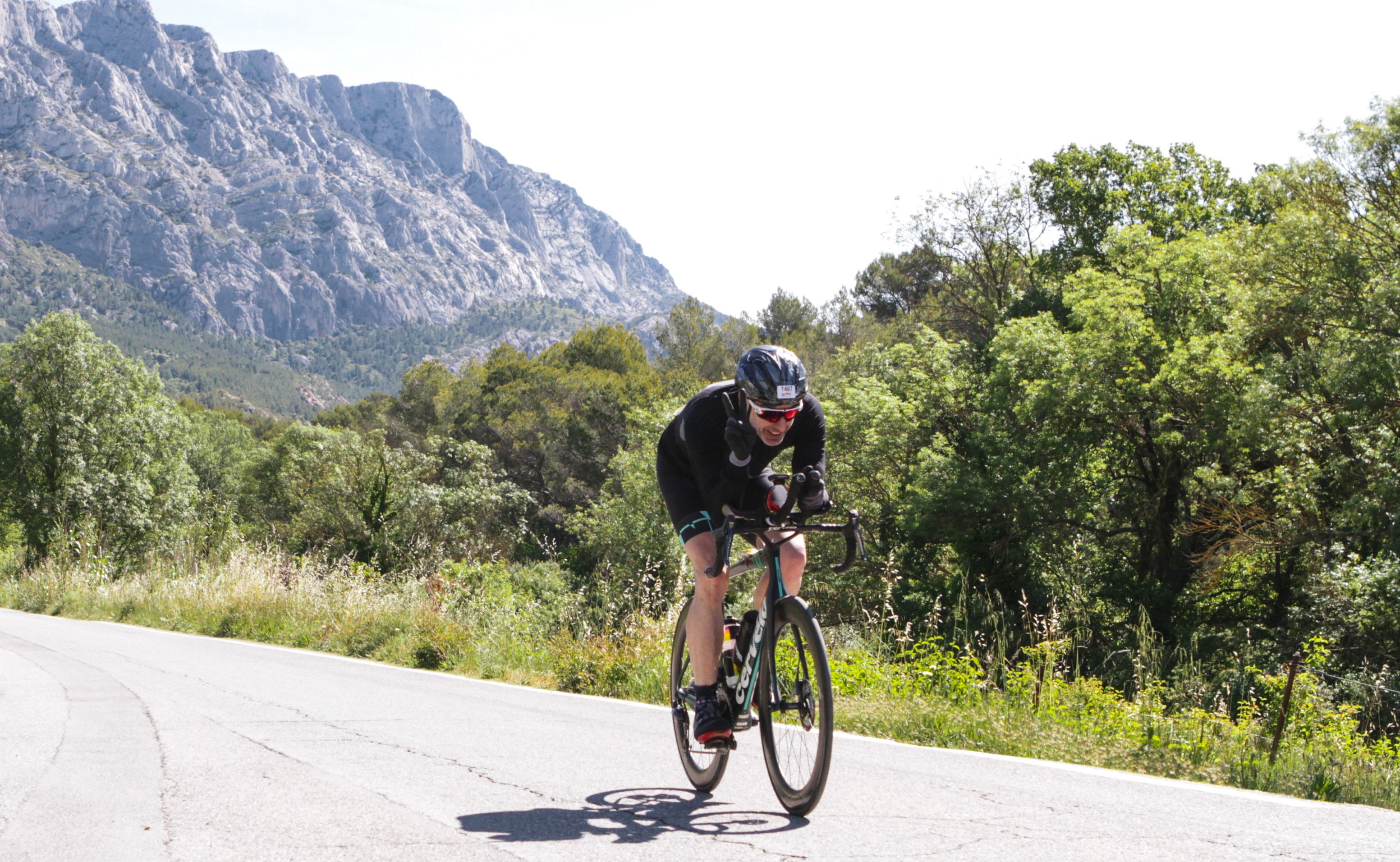
Ironman 70.3 Aix-en-Provence, 2026
Around kilometre sixty-five of the bike leg at Ironman 70.3 Aix-en-Provence, I started the penultimate climb of the day.
It is not a brutal hill on paper. Twelve minutes or so. But the whole first half of the bike course is a mental exercise in not killing the climb that arrives at hour two and a half — because there is still another fifteen kilometres of rolling road after it, and then a half marathon to run.
I rode up that climb at 245 watts. My FTP is 273. I could have pushed more. I had the legs. I didn't.
There was nothing happening in my head. No bargaining. No what-if. I knew the gear I was in. I knew the wattage I was holding. I knew that the rest of the day on the bike was a hold, not a race, and that the race was the run that came after the bike.
Just execution.
That feeling — the absence of internal noise — is what eighteen months of working with a good coach actually buys you. It is not a fitness gain. It is a cognitive gain. The fitness is a side effect.
It is also, almost exactly, what I am trying to buy for the first-time CTOs and CPOs I mentor.
The novice's signature move is doing more things, harder
Last year, at my first half Ironman, I trained somewhere between seven and nine hours a week. I finished. I was proud. I had no idea what I was doing.
Yes I was disciplined but I rode hard when I felt good, even if the plan was saying otherwise. I skipped recovery because it felt like wasted time (not proud of this but it's true, and we tend to do it so often in worklife..). The race itself was an emotional event. I went out too soft on the bike, so much so that my heartrate started going down instead of up. The start of the run I pushed an impossible pace for 7Km, then my legs wanted to kill me. I crossed the line as a story I told myself about willpower and pain-avoidance.
This year I trained eleven to thirteen hours a week. Almost twice as much. And the race was nothing like an emotional event. It was a controlled, almost boring execution of a plan. I finished faster, fresher, and with enough left in me to jump under the finish arch instead of collapsing under it.
The interesting thing is not the training volume. The interesting thing is the texture of the time. The same hours, spent badly, would have produced a worse outcome than last year. Possibly an injury.
What changed is that I learned to listen to my coach and asked her a personal plan, instead of a generic one (this of course costed more, but it was an investment in me).
What I paid Kaisa for, and what she actually delivered
I assumed I was buying a training plan.
What I actually bought was the absence of
decisions I am not qualified to make.
Every morning when I open the calendar, the workout is already there. I don't sit and weigh whether today should be intervals or zone two. I don't bargain with myself about whether the long ride should be five hours or six. I don't listen to half an episode of a Norwegian-method training podcast and start wondering if I need to buy a lactate meter. (I asked Kaisa about that one once. She told me not to bother.) Someone with twenty years of doing this professionally has already made all of those decisions for me, in the context of who I am, what I am building toward, and what week of the year it is.
That is what removes the noise.
A first-time CTO has the same problem.
You wake up on a Monday and the calendar is empty. You do not know whether this is the week you sit down with the founders about the hiring plan, or the week you finally do something about the production incident pattern, or the week you go heads-down on the rewrite question that has been hanging over you for a month. There is no syllabus. There is no plan. There is only the volume of decisions you do not yet have the experience to make confidently, and the volume of time that gets eaten by you re-litigating them with yourself.
A mentor does not solve your business for you. A mentor sits next to you for the hour a fortnight when you stop and look at the calendar honestly, and asks the question that makes the next three weeks obvious.
That is a smaller intervention than people imagine. And it is the entire job.
The boring stuff is the strategy
If you had asked me a year ago what would make me faster, I would have said something about FTP, threshold intervals, learning to suffer.
What actually made me faster was sleep. Hydration. One hundred and twenty grams of carbs per hour on the bike, sixty-seven on the run — clinical numbers I checked the way other people check the time. Saunas after long sessions, because in Finland you can grow your plasma volume by sitting still in a hot room, and that is the kind of compounding nobody posts on Strava. Doing the same long ride, the same Saturday morning, that I had done the Saturday before. Boring, fundamental, repeatable.
It turned out that the exciting workouts — the interval sessions everyone posts about — were the smallest part of the actual gains. The big part was the unsexy compounding of the basics, done consistently, for a year.
In leadership it is the same.
Your one-on-ones are the long ride. Your hiring process is your nutrition. Your planning rhythm is your sleep. None of them is exciting. None of them is the thing you brag about at the conference. They are the substrate on which everything else either works or doesn't. It's what is called the endurance base.
As a first-time CTO you might come to me with the exciting questions. The architecture rewrite. The AI strategy. The reorg. We talk about those — of course we do. But four times out of five, the actual blocker is that the one-on-ones are status meetings, the hiring funnel is broken, and there is no planning rhythm to speak of.
The strategic work, in other words, is not the work that sounds strategic.
Why I hired a coach at forty-five
This part is short, because it deserves its own post.
I hired Kaisa before I had even committed to my first triathlon. Many people spoke highly about her and at the end I gave in and wrote her an email.
I was forty-five years old and I had had this crazy thought for a while already — vaguely, the way you think about things when you're not yet honest about wanting them — about doing an Ironman. And the thing I knew, with the kind of clarity you only earn by being forty-five, is that signing up for an endurance event of that scale without someone overseeing how I prepared was not ambition. It was a way to hurt myself. Possibly seriously.
That is the part senior people understand and beginners do not. The skill is not pushing harder. The skill is recognising — early, before anything has gone wrong — that you are about to walk into a domain where you do not know what you do not know. And then hiring the person who does, before you take the first step.
As an experienced leader, you know you want someone in your corner when you do not know what you are doing. That instinct is most of the career skill. Trust it earlier than feels comfortable.
The first-time CTOs, CPOs, VPs who reach out to me before the wheels come off are not weak. They are doing the senior-person thing. The ones who wait until they are six months into a crisis to ask for help are not braver. They are just paying a higher price for the same lesson.
In sport, nobody argues about this
Here is the thing I find genuinely astonishing.
If you decide to take up tennis, you join a club. There is a coach there waiting. You pay the membership and a slice of that is the coach's salary. You don't get a say in the arrangement, and nobody thinks it strange. Same for football, volleyball, cycling, swimming. Curling, even.
The idea that you would learn the sport by reading some book about it or watching some videos on YouTube, alone, in your garage, is faintly absurd. Of course you have a coach. Everyone has a coach. The only question is which one and can you find the best one that your money can buy.
In business, the inverse holds. The default assumption is that you can figure out how to lead — people, capital, technology, expectations, your own ego — by reading a few books, going to a conference once a year, and watching the senior people around you do it badly. University is treated as the end of training. It is barely the start.
The executives who break this default — who actually pay for a coach, a mentor, a thinking partner — are not the ones who needed the most help. They are the ones who understood, earlier than the rest, that the sport they are playing is harder than the one most people give it credit for, and that nobody in the room is going to coach them by accident.
Everyone else is figuring it out alone. Slowly. Expensively. And the cost shows up in their teams long before it shows up in their own performance reviews.
What you are actually buying when you hire a mentor or a coach
You are not buying answers. If you wanted answers, you'd hire a consultant (by the way I do that too if you are really interested in answers :D )
You are buying:
- A second pair of eyes that has already seen this movie. Not in your specific company — that is not possible — but in a company like enough that the patterns rhyme. Most of the things you think are unique to your situation are not. That is, paradoxically, a relief.
- The removal of one category of decisions. Like the workout already being in the calendar on Monday morning. You stop relitigating questions that someone with twenty years of context can settle in ten minutes.
- Honest pushback from someone with no skin in your political game. Your founders, your boss, your team, your investors — they all have stakes in your decisions. A mentor does not. That makes them one of the very few people in your professional life who can tell you the unflattering version.
- Permission to slow down. You think you are hiring someone to make you faster. Often the most valuable thing they will tell you is that the thing you are sprinting toward isn't the thing.
That last one is the one nobody warns you about. I expected to be pushed harder. What I learned instead was the opposite — and it is the lesson most endurance athletes have to swallow before they get any good.
Most of the work happens at very low effort. The training model elite endurance athletes follow — Norwegians included — is roughly 80/20: eighty percent of your training is easy. Boringly easy. The kind of easy where you feel like you are not really training. The remaining twenty percent, the hard intervals everyone posts about, is what gets all the attention — but it only works because of the eighty that doesn't.
Beginners, including me, want to invert that ratio. Every session has to count. You feel that you have little time to waste. You push when you should glide. You turn the easy day into a moderate day, and the moderate day into a hard day, and you wonder why you are constantly tired, don't manage to push hard when you should and you are not getting any faster. The base is what makes the hard efforts hard, and most amateurs never build it.
Most of the CTOs I mentor do exactly the same thing in their work. They are optimising for the wrong scarce resource. They think their bottleneck is hours. It is almost always judgment, thinking, decision making. More hours, applied at the wrong intensity, makes the situation worse, not better.
Almost effortless is the goal. But don't confuse it with easy.
The race in Aix was the closest I have come to feeling that I knew what I was doing. Not as a pro — I am not a pro and never will be — but as a person who had done the work, with the right help, for long enough that the right things had become automatic.
It felt almost effortless. That is not the same as easy.
It cost a year and a half of consistent, unspectacular training, a coach I trusted, and the discipline to do the boring thing on the days I felt like doing the exciting thing.
That is also what good leadership feels like, when you finally have it. Not heroic. Not dramatic. Almost boring. Right pacing. Right decisions. The right amount of energy still in reserve when it matters (because you will need it).
The first time it happens to you in your career, you will not believe it is happening. You will look for the catch. You will assume you are missing something. You will think you are cheating almost. Or maybe that this is a candid-camera.
You are not missing anything. You have just done the work. Relax.
That is the result of coaching and mentoring. It is what I am trying to give to the CTOs and CPOs I work with. And it is, quietly, the most valuable thing I know how to deliver.